
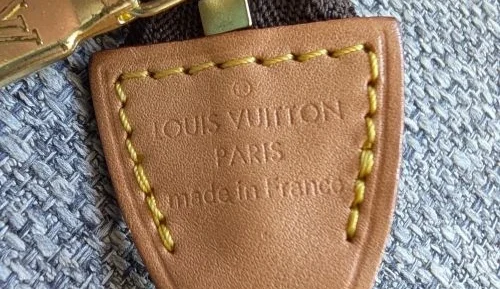
Quick answer: The quickest way to tell if a Louis Vuitton bag is real is to check the date code or microchip, stitching, leather quality, hardware and logo engraving together. No single detail proves authenticity on its own, but inconsistencies across several of these areas can be a strong warning sign.
If you’re buying a second-hand Louis Vuitton bag, the safest approach is to look at several details together rather than relying on just one. Authentic bags tend to be consistent in their date code or microchip, stitching, leather, hardware and overall finish.
What to check first
- the date code or microchip
- stitching and leather cuts
- how the leather has aged
- the zipper and hardware
- the logo and engraving
- FAQ
I’m using authentic Louis Vuitton examples throughout this guide, including bags from my own collection, so you can see what genuine details look like in real life.
1. Check the Date Code or Microchip
One of the first things to check is whether the bag has a date code or, in newer models, a microchip. A date code is not proof on its own, since counterfeit bags can copy one too. That said, fake bags often reuse the same codes across multiple listings, especially on sites like eBay, whereas authentic Louis Vuitton bags show much more variation. Microchips are generally harder to imitate, but both should still be considered alongside the stitching, materials, hardware and overall craftsmanship.
How to Read a Louis Vuitton Date Code
Let’s take an example of my Mini Pochette (I bought this in a Louis Vuitton store). You can see the leather tab says “Made in France” – by the way, Louis Vuitton products can be made in either France, Spain, Italy, US, Germany or Switzerland and when it is made in US, they don’t stamp it as “Made in US”, rather they leave it blank so don’t worry even if your bag does not have “Made is” stamp.
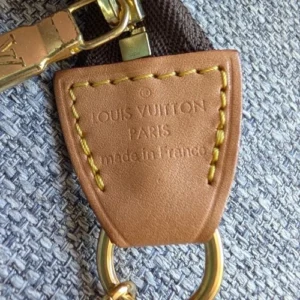
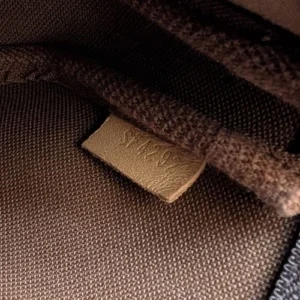
My date code says “SF4292.” What does that mean?
- The first two letters are the country code (SF is one of France’s codes).
- The four numbers show when the bag was made:
- First and third numbers = week of production
- Second and fourth numbers = year of production
So “SF4292” means the bag was made in the 49th week of 2022 (around early December).
A quick authenticity check: If the country code and “Made in” stamp don’t match (like an SF date code but “Made in Spain” stamped inside), or if the date is impossible (e.g., 2239—23rd week of 2029?!), it’s probably fake.
💡 A heads-up: Multiple bags can have the same date code since they’re made in batches, but if you see tons of listings online with the exact same one, be cautious!
The date code rule has changed over time, and this rule applies to bags made in 2007 and later. Before 2007, they used the month number instead of the week number. Even much older bags had different numbering rules—you can check out the Louis Vuitton Product Code Authenticator.
How to Check a Louis Vuitton Microchip
Microchips are a newer thing for Louis Vuitton, introduced in 2021. Bigger bags, like the Neverfull, now have microchips instead of date codes. My Mini Pochette bought in 2023 doesn’t have a date code, for example. Here I use my Neverfull as an example to show you where the chip is.
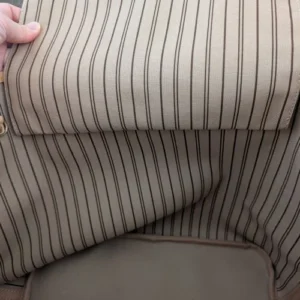
The Neverfull used to have a date code tab on the back of the interior pocket, but my new Neverfull, purchased in 2023, doesn’t have one.
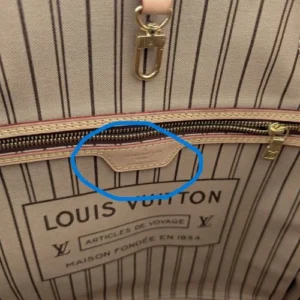
Newer bags have microchips – for example, Neverfull has one on the back of the leather tab in the center of the internal pocket (blue circle).
There’s no official Louis Vuitton app to scan these chips, but third-party apps like NFC Tools (available at Apple Store and Google Play). Just hold your phone near where the chip is located and see if anything pops up.
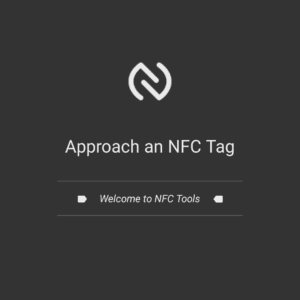
This is the screen that appears when you open the app.
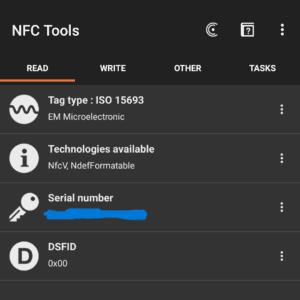
If you scan the microchip, you will see something like this. The serial number consists of a random combination of numbers and letters.
People say Louis Vuitton staff have their own scanning app to verify microchips in-store, but since I don’t work for LV, I can’t confirm that. Still, it’s something to keep in mind!
Again, there is a small chance that counterfeiters could create a fake microchip (similar to a cloned bank card with a chip), but I would say the likelihood is not very high.
2. Check the Stitching and Leather Cuts
One of the easiest ways to spot a fake bag is by looking at the stitching and leather cutting. Counterfeit bags often have sloppy stitching and uneven leather shapes.
Let’s use my Neverfull as an example:
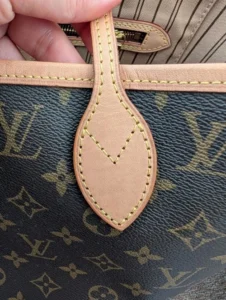
- The stitching on the V-shape and leaf-shaped leather parts is perfectly even on both sides.
- The stitches are consistent in length—no tiny or stretched-out stitches at the end to “adjust” the spacing.
- The edge of the stitching is always the same distance from the edge of the leather.
Now look at this fake-looking Neverfull example from a thrift shop listing, which shows several red flags:
- The V-shaped stitching at the bottom is missing double-stitching.
- The leaf-shaped leather parts are uneven and wobbly.
- On the right side, the stitching is too close to the leather edge.
- No proper “edge creasing” (a subtle line along the leather edge that authentic bags have). This process is either skipped or done very roughly in counterfeit bags in many cases.
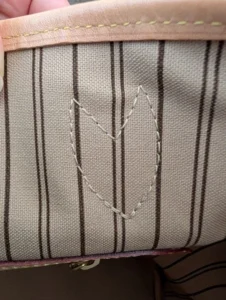
If you take a closer look at my Neverfull, you’ll notice that the bottom edge of the V-shaped stitching is double-stitched. This small detail is a good indicator of an authentic bag.
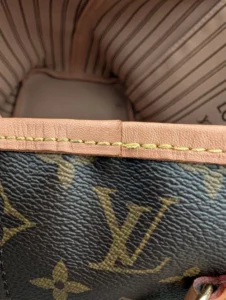
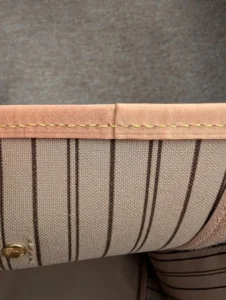
Also, check the leather edges—authentic ones are clean-cut and straight, while fake ones are often rough or cut at an angle.
3. Check How the Leather Has Aged
If you’re buying a pre-loved bag, checking how it has aged can be a great indicator of authenticity.
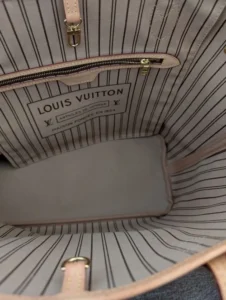
I bought this Neverfull 2 years ago, but it still looks very pristine – at least, there are no weird bobbles. Authentic Louis Vuitton bags are very sturdy and almost scratch-proof (at least for the exterior and interior of Monogram bags).
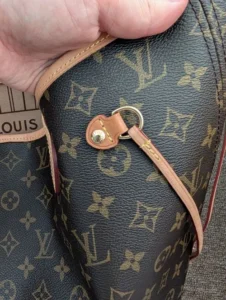
It’s normal for some leather parts to have a lighter color while others are darker, as they are natural materials and each piece gets tanned slightly differently. For example, in my Neverfull bag, even though it’s almost in the same area, the small leather piece that attaches the D-ring to the bag is much darker than the cinching strap.
However, if the difference is excessive – unless it is repaired and replaced with a newer leather at some point, it is weird if the tanning of one part is very different from another. You often see bags like Speedy, where they have pipings around the corner, the fake bag manufacturers want to make bags as cheap as possible, so they use artificial leather (they don’t get tanned) for parts like pipings, ending up making it much whiter than other leather parts as the time goes.
A beautiful patina, like this example, is often a good sign of authenticity.
4. Check the Zipper and Hardware
If you’ve ever owned an authentic Louis Vuitton piece, you know what their zippers feel like. I think this is probably my favorite part of owning Louis Vuitton items. To illustrate, I’ll compare the zippers on my Mini Pochette and Le Pliage from Longchamp (by the way, I love Longchamp, and this is just to compare how they sound/feel differently). Both have zippers that are very smooth, but you’ll notice that Louis Vuitton’s zipper feels much heavier, both in how it’s pulled and in the sound it makes.
I’ve also included a video of my Zippy Coin Purse in this article, so you can see how it feels and hear the signature sound of Louis Vuitton’s heavy zipper.
5. Check the Logo and Engraving
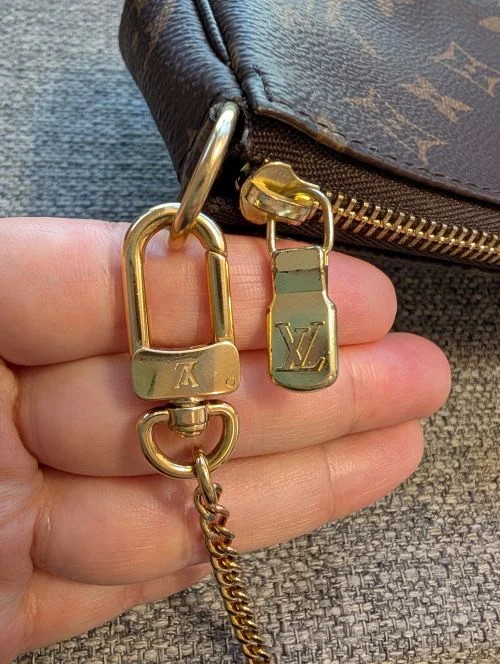
Last but not least, engraving is an area that fake bags often “miss.” The metal parts of an authentic bag have very clear engravings – the LV logo features thin, finely crafted lines. In contrast, fake bags often have dull or shallow engravings. If the shape of the LV logo looks uneven or if you feel the edges of the engraving are not sharp and are rough, it could indicate the bag is fake. For example, on my Mini Pochette, the zipper pull and the hook of the metal chain seem to be made of different materials, and the zipper pull feels much heavier.
FAQ
Do all real Louis Vuitton bags have a date code?
No. Many older Louis Vuitton bags have date codes, but newer bags may use microchips instead. The absence of a visible date code does not automatically mean a bag is fake.
Can fake Louis Vuitton bags have date codes?
Yes. A fake bag can include a copied or misleading date code, which is why this detail should never be checked on its own. It is better to assess the date code together with the stitching, leather, hardware and overall craftsmanship.
What are the easiest signs that a Louis Vuitton bag might be fake?
Common warning signs include uneven stitching, poor-quality leather, sloppy engraving, suspiciously lightweight hardware and details that do not line up with the bag’s age or country of manufacture. One small flaw may not prove anything, but several inconsistencies together are a red flag.
What should I ask a seller before buying a second-hand Louis Vuitton bag?
Ask for clear close-up photos of the date code or microchip area, stitching, corners, leather, hardware, logo stamp and interior. It also helps to ask when and where the bag was bought, whether the seller has the original receipt or dust bag, and if there are any signs of wear or repairs. These details do not prove authenticity on their own, but they can help you assess whether the bag looks genuine and whether the seller seems trustworthy.
Can Louis Vuitton confirm whether a bag is authentic?
In some cases, a store may give an informal opinion or refuse service on an item they believe is not authentic, but buyers should not rely on this as a guaranteed authentication service. It is safer to assess the bag carefully before buying.
I hope this guide helps you spot a fake before making a purchase. When in doubt: ✔️ Use a professional authentication service. ✔️ Buy from platforms like eBay that offer authenticity guarantees. ✔️ Research the seller and cross-check date codes/microchips. ✔️ If the price is too good to be true, it probably is.
While second-hand shopping is a great way to save money, there’s always some risk involved. Personally, if a bag is still available in stores, I’d rather buy it new – but that’s just me. Let me know your thoughts in the comment section!

Leave a Reply