
Before Louis Vuitton
Kusama was born in Matsumoto, Nagano, in 1929 and began drawing when she was young. She later described experiencing hallucinations from childhood, including patterns that seemed to multiply and cover her surroundings. Those experiences became central to the repeated nets, dots and other motifs that eventually defined her work.
She studied traditional Japanese painting before moving to the United States in 1957. In New York, she developed her large-scale Infinity Net paintings, soft sculptures, mirrored installations and performance-based “happenings”, becoming part of the city’s avant-garde art scene during the 1960s. She also worked across film, publishing and fashion rather than restricting herself to painting.
After returning to Japan in 1973, she continued producing art and writing. From 1977 she voluntarily lived in a psychiatric hospital in Tokyo while working from a nearby studio. Her international reputation grew dramatically again from the late 1980s onwards, eventually leading to major exhibitions at museums around the world and the opening of the Yayoi Kusama Museum in Tokyo in 2017.
The dots that became her signature
The Louis Vuitton story makes much more sense if you explain that Kusama’s dots weren’t simply a decorative pattern.
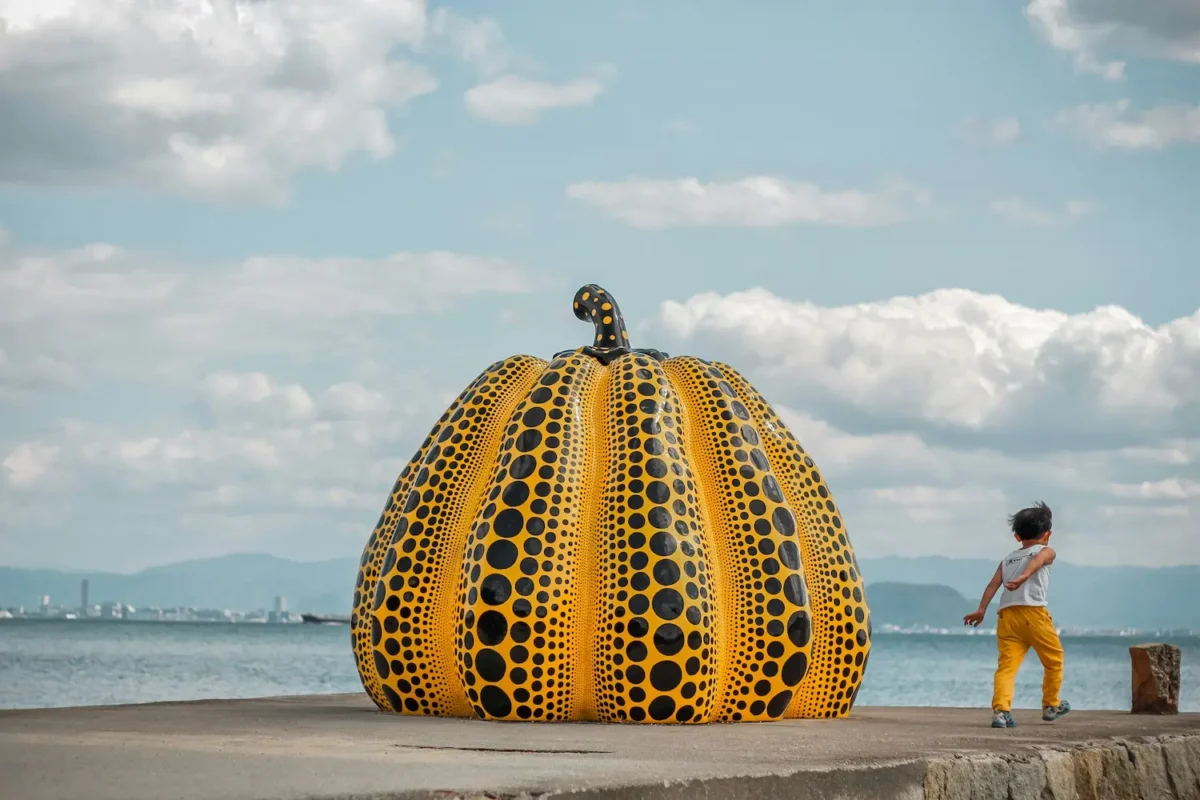
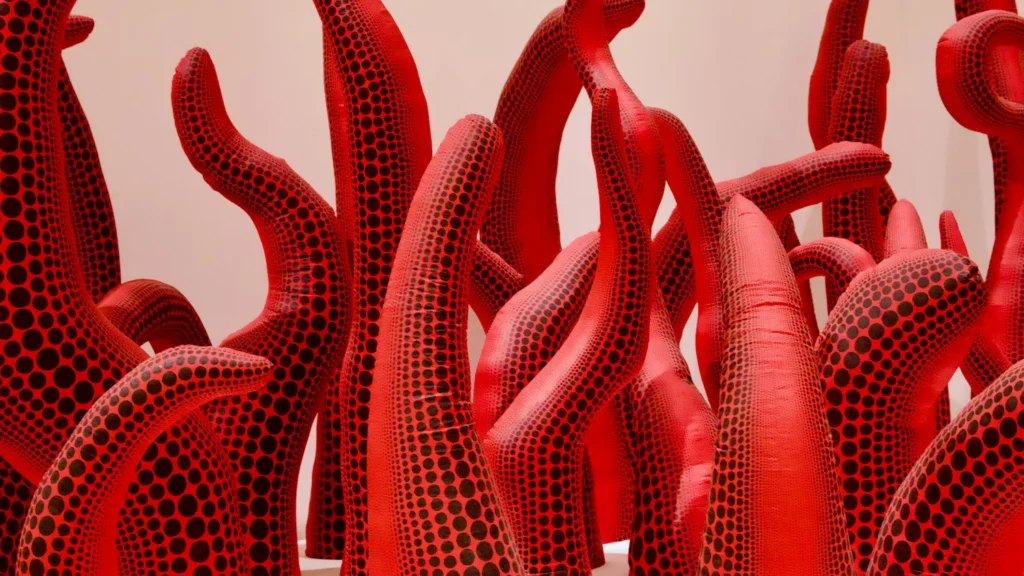
Repeated dots, nets and organic forms were tied to her idea of self-obliteration – dissolving the individual into an apparently infinite surrounding world. Her pumpkins, flowers, mirrored spaces and dots all grew from a visual language she had been developing for decades before luxury fashion adopted it.
That distinction is useful for the article because it explains why the Vuitton collaborations worked so well: Louis Vuitton wasn’t simply putting fashionable polka dots on a Speedy. It was adapting an immediately identifiable artistic vocabulary.
Kusama’s relationship with fashion before Louis Vuitton
She was already crossing art and fashion long before the Vuitton partnership.
In New York in the 1960s, she staged performances and created clothing as part of her broader artistic practice. Later, commercial collaborations brought her visual language to a much wider audience.
For example, in 2011 she collaborated with Lancôme, creating six polka-dot designs for limited-edition Juicy Tubes.
How Yayoi Kusama and Louis Vuitton began collaborating
Yayoi Kusama’s relationship with Louis Vuitton began through Marc Jacobs, then the house’s artistic director. Jacobs first met Kusama in 2006 when he visited her studio in Tokyo. Already an admirer of her work, he was particularly drawn to the obsessive repetition and sense of infinity that ran through her paintings and installations. Louis Vuitton itself credits Jacobs with initiating the house’s relationship with Kusama.
The partnership developed into a full collection in 2012. Earlier that year, Louis Vuitton had supported Kusama’s retrospective at Tate Modern in London, before launching the first Louis Vuitton x Yayoi Kusama collection in July. The collaboration centred on Kusama’s signature polka dots, which appeared across handbags, ready-to-wear, shoes, scarves and accessories.
Louis Vuitton x Yayoi Kusama returns in 2023
More than a decade later, Louis Vuitton returned to Kusama for a second collaboration in 2023, this time under Nicolas Ghesquière. The scale was considerably larger. Rather than simply revisiting the 2012 collection, the house drew from a broader range of Kusama’s motifs and techniques, turning the project into a survey of her visual universe.
The collection reportedly included around 450 pieces and extended across leather goods, ready-to-wear, shoes, accessories and other categories. Louis Vuitton developed different treatments to recreate the appearance of Kusama’s hand-painted dots, while other pieces referenced her pumpkins, flowers and sculptural forms.
Leave a Reply